- 10919 Stancliff Rd, Apt 4107 Houston, TX 77099
- info@nexibloom.com

Office Address
10919 Stancliff Rd, Apt 4107 Houston, TX 77099
10919 Stancliff Rd, Apt 4107 Houston, TX 77099
 by Nexi Bloom LLC


The first properly hot week of the year always goes the same way. The heat settles in, somebody's upstairs bedroom stops cooling, and by lunchtime thousands of people across Houston are typing some version of "AC repair near me" into their phones. Every HVAC company in the city gets busy. A handful of them get a lot busier, because they are the ones Google shows first.
Those companies did not get lucky in June. They did the work in January, February and March, when the phones were quiet and there was time to build pages, clean up a Google Business Profile and collect reviews. By the time the heat arrived, Google already knew who they were.
If you have read our guide to SEO for Houston plumbers, you will recognize the idea. Pages need to exist and be indexed before the season starts, not during it. For HVAC, the season is bigger, longer and more predictable, which makes the timing even more important.
This guide covers what Houston homeowners actually search for, a month-by-month calendar, Google Business Profile setup, reviews, the pages your website needs, costs and timelines.
Key takeaways
- Houston AC demand is predictable. It builds every spring and peaks through the summer.
- New pages take days to weeks to be crawled, and longer to rank. Building in April is too late for that summer.
- January to March is when to publish service pages, fix your Google Business Profile and push for reviews.
- Reviews work best as a steady habit all year, not a scramble in July.
- In peak season, your job is to capture calls, not to build new pages.
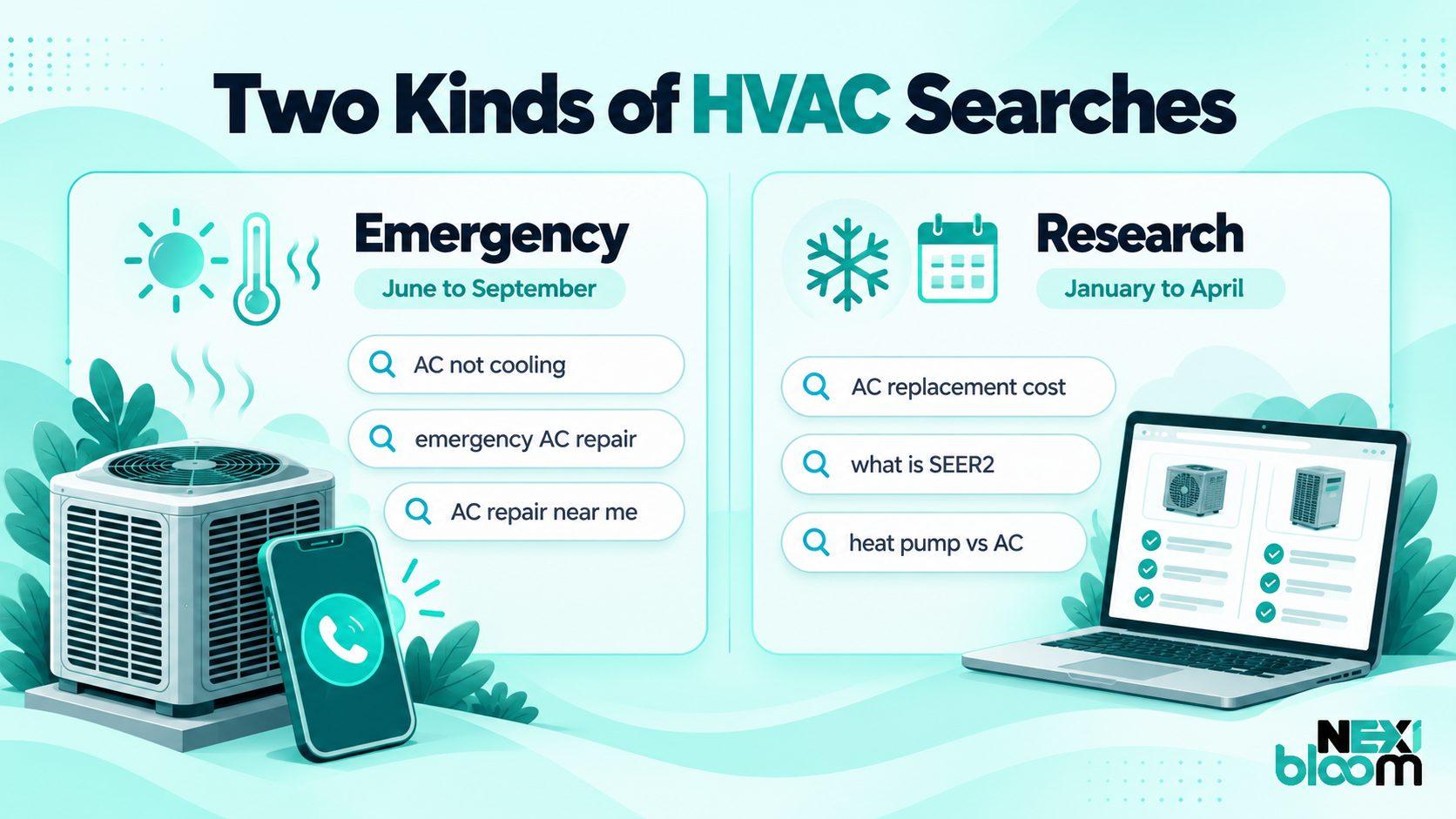
HVAC search behavior splits into two very different moods, and most HVAC websites only serve one of them.
When a system fails in a Houston summer, the person searching is hot, stressed and often has kids or elderly parents in the house. They search things like "AC not cooling," "AC blowing warm air," "emergency AC repair" and "AC repair near me open now." They are not comparing brands or reading articles. They want a phone number, a sense of how soon someone can come out, and some reason to trust you over the next result.
These searches are dominated by the map pack, the three business listings that appear with a map above the regular results. If you are not in it, many of these people never scroll far enough to find you.
Earlier in the year, a different homeowner is searching. Their system limped through last summer, it is fifteen years old, and they want to know what they are in for. They search "AC replacement cost Houston," "what is SEER2," "heat pump vs AC in Houston," and "is an AC maintenance plan worth it."
This is high-value work. A replacement is worth many times more than a repair call, and these people research for weeks before they pick up the phone. Whoever answers their questions well in February is the company they call in April.
Houston is not only a summer market. Freezes, like the one in February 2021, send heat pump and furnace searches up sharply for a few days at a time. It is a smaller slice of the year, but the same rule applies. The heat pump page has to be live and ranking before the cold snap, not written during it.
| Search type | What the searcher wants | Best page to send them to | When demand builds |
|---|---|---|---|
| Emergency repair ("AC not cooling") | A fast, trustworthy call | Emergency AC repair page and Google Business Profile | Late spring through summer |
| Replacement research ("AC replacement cost") | Honest pricing and options | Replacement page plus a cost guide | Winter and early spring |
| Maintenance ("AC tune-up") | Prevent a summer breakdown | Maintenance plan page | Early spring |
| Heating ("heat pump not heating") | Heat back on, quickly | Heat pump and heating repair page | During freezes |
Most HVAC owners know their busy season better than any marketer ever will. What trips them up is not knowing when demand arrives. It is how long SEO takes to respond.
Picture the year as a wave. Searches for AC work start climbing as spring warms up, rise steeply into late spring, stay high through the long Houston summer, then ease off through the fall. Winter is mostly quiet, with short, sharp spikes whenever a freeze hits. The exact shape shifts a little each year with the weather, but the pattern does not change. Every summer, it happens again.
That predictability is the opportunity. You know the rush is coming. The only question is whether your pages are ready for it.
When you publish a new page, Google has to find it, crawl it, index it and then decide where it deserves to rank. Google itself says crawling can take anywhere from a few days to a few weeks. That is only the first step. Ranking well for competitive local terms usually takes longer, because Google is weighing your page against competitors who have been there for years.
Reviews are slower still. You cannot collect fifty good reviews in a month without it looking strange, and you would not want to try.
So a company that decides in April to "do some SEO before summer" is starting a process that will not pay off until the season is half over. Worse, April is when crews are getting busy, and the marketing work gets pushed aside the moment the phones start ringing.

| Month | Focus | What gets done |
|---|---|---|
| October to December | Audit and plan | Review last season's calls and jobs, check rankings, list missing pages, fix technical problems |
| January | Build | Publish or rebuild core service pages: AC repair, replacement, maintenance, heat pumps |
| February | Google Business Profile and reviews | Update categories, services and photos. Start a steady review routine |
| March | Pre-season content | Publish tune-up, maintenance plan and replacement cost content |
| April to May | Promote | Push maintenance plans to existing customers and fill the schedule early |
| June to August | Capture | Answer every call, respond to every review, avoid big site changes |
| September | Harvest and review | Ask summer customers for reviews, check what worked, plan for next year |
Here is an illustration, not a client story. Two companies of similar size serve the same part of west Houston. One rebuilds its AC repair page, fixes its Google profile and starts asking for reviews in January. The other decides in May that it needs "more leads" and hires someone to start SEO. By July, the first company is showing up in the map pack for the neighborhoods it serves. The second has new pages that Google has only just started to trust, and it spends the summer paying for ads to make up the gap. Neither company did anything wrong in the work itself. One of them just started four months earlier.
For emergency searches, your Google Business Profile often matters more than your website. It is what appears in the map pack, and for many callers it is the only thing they look at before they dial.
Most HVAC companies are service-area businesses. You go to the customer, and customers do not visit your office or yard. Google's guidelines for service-area businesses say you should hide your address from customers in that case. Leaving a home address visible is a common reason profiles get suspended, and a suspension in May is about the worst timing imaginable.
Google still needs a real address behind the scenes for verification. PO boxes and virtual offices are not eligible, and using one is a fast way to lose the profile.
You can add up to 20 service areas, and Google's guidelines say the overall area should not extend much beyond about two hours of driving from where you are based. For a Houston company, that might mean areas like Katy, Sugar Land, Pearland, The Woodlands, Cypress, Spring, Pasadena and Humble.
Be honest here. Listing areas you cannot reach quickly in July does not help anyone, and it leads to exactly the reviews you do not want.
Your primary category has the biggest effect on which searches you appear for, so choose the one that matches most of your work. Add secondary categories for the other services you genuinely offer, then fill in the services list in detail, including AC repair, AC installation, maintenance, heat pump repair and duct work.
Only list 24/7 hours if someone really answers the phone at 2am. If they do, it is a genuine advantage. If they do not, the missed calls and reviews that follow will cost you more than the hours earned.
Upload real photos of your trucks, your technicians and finished installs during the quiet months. Add a few posts about maintenance plans in early spring. It is much easier to do this in February than in the middle of a July week with every crew out on calls.
If you want help getting this right, our team handles local SEO for service-area businesses across Houston.
<!-- Once Piece 12 (Google Business Profile for Service Area Businesses) is live, link to it here. -->
Reviews are one of the clearest signals Google uses for local rankings, and they are one of the first things a stressed homeowner reads. They are also the one part of SEO you cannot rush.
The best time to ask is right after the fix, while the house is cooling down and the customer is relieved. That is when people feel most generous and remember exactly what went well. A short text with a direct link to your review page, sent by the technician or the office the same day, works far better than a generic email a week later.
Aim for a steady flow rather than bursts. A company that gets a few new reviews every week, all year, looks more trustworthy to customers and to Google than one that gets thirty in a single week and then nothing for months. Build the habit in the quiet months so it is automatic by summer.
Reply to every review, including the difficult ones. In August, someone will eventually leave a frustrated review because they waited three days for a technician. A calm, specific reply that explains what happened and what you did about it reassures the next reader far more than silence does.
Stay within Google's rules. Do not offer discounts or gifts in exchange for reviews, and do not screen customers so that only happy ones are asked. Both break Google's policies and can get reviews removed or the profile penalized.
Your Google profile gets the attention. Your website is what closes the deal, especially for bigger jobs where people want to know more before they call.
Think about the person reading it: on a phone, in a hot house, probably frustrated. The page should make calling you the easiest thing in the world.
Long paragraphs about your company history can live on the About page. This page has one job.
A single "Services" page listing everything you do will not rank for much of anything. Google needs a page that clearly matches the search. Build separate pages for:
That last one deserves more attention in Houston than most companies give it. Humidity here is a year-round problem, and homeowners search for help with sticky air, mold smells and systems that cool but never feel dry. Few competitors write about it well.
Each page should explain the problem, the likely causes, how you fix it and what it usually involves, in plain language. If you need help writing them, our service page copywriting is built for exactly this.
Most emergency searches happen on a phone, often with a weak signal. A page that takes several seconds to load loses calls to the competitor whose page loads straight away. Compress images, avoid heavy sliders and pop-ups, and test your pages on a real phone rather than just a desktop browser. If your current site is slow and hard to update, a fast, mobile-first website is often a better investment than more content.
HVAC contractors in Texas are licensed through the Texas Department of Licensing and Regulation. Displaying your Texas air conditioning and refrigeration contractor license number on your site, along with insurance details and EPA refrigerant certification for your technicians, gives careful homeowners a reason to choose you. Check TDLR's current rules on where the license number must appear so you are compliant as well as persuasive.
<!-- Writer note: confirm TDLR advertising rules before stating any legal requirement about license display. -->
Add structured data to your site using the HVACBusiness type, which is a more specific version of LocalBusiness. Make sure the business name, phone number and service details match your Google Business Profile exactly. Schema does not rank a page by itself, but it helps Google connect your website, your profile and your services without guesswork. Our local SEO services include setting this up properly.
Once the core service pages exist, the obvious next step is pages for each area you serve. This is where many HVAC sites go wrong.
The mistake looks like this: thirty pages titled "AC Repair in [City]," each one identical except for the city name. Google calls these doorway pages, and it treats them as low-quality. At best they do not rank. At worst they drag down the rest of the site.
A useful area page says something that is only true about that area. Housing stock is a good place to start. A lot of Katy is newer construction in large planned communities, with different systems and problems from the older homes in the Heights or Bellaire, where ductwork and attic space can be very different. Response time is another. If you have a technician based near Pearland, say so and say what that means for customers there.
Real job notes help most. A short description of a recent replacement in Cypress, with photos and the problem you solved, is worth more than any amount of generic copy. It shows Google and the reader that you genuinely work there.
Start with a small number of strong area pages for the places that bring you the most valuable work. Add more when you have something real to say about them. For a sense of how this looks in practice for nearby markets, see how we approach local SEO in Katy and local visibility in Sugar Land.
The quiet months are the best time to answer the questions homeowners research before a big decision. These are the articles worth publishing between January and March:
Each article should link to the matching service page, so a reader who is ready to act can get there in one click. Published in winter, these pages have months to be crawled and build trust before the people reading them are ready to buy.
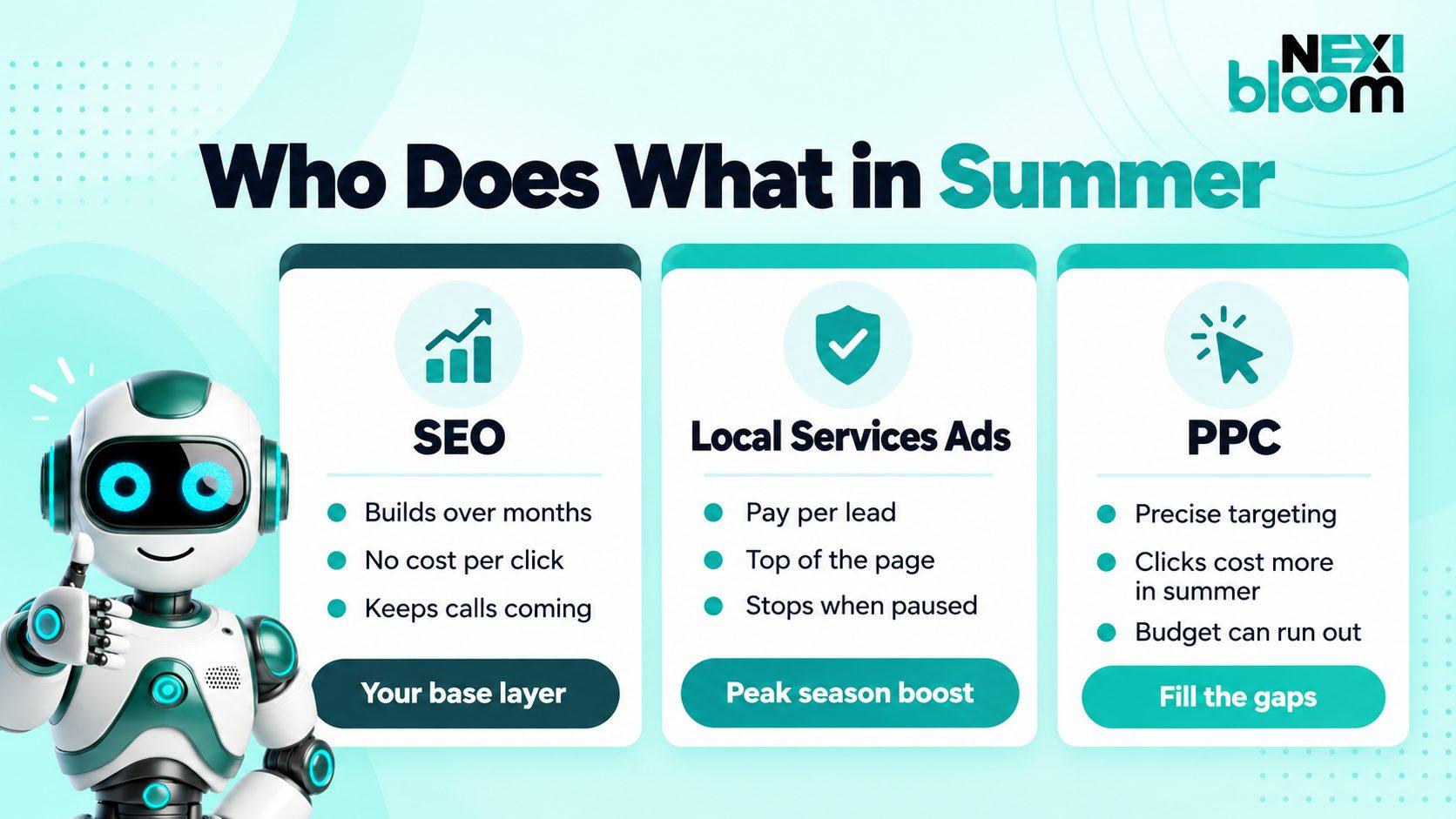
Most established HVAC companies use more than one channel, and they work best when each one does its own job.
Local Services Ads are the listings that appear at the very top of many searches with the Google Guaranteed badge. You pay per lead rather than per click, and HVAC companies can qualify after background and license checks. They are a strong option in peak season, but the budget runs out and the leads stop the moment you pause.
PPC, meaning standard Google Ads, lets you target specific searches and areas precisely. In summer, many competitors bid on the same emergency terms, so clicks tend to get more expensive right when you need them most. Good PPC management helps, but it cannot change the underlying competition.
SEO is the base layer. It takes longer to build, but once your pages and profile rank, they keep producing calls without a per-click cost. On the days when your ad budget is spent by 11am, organic rankings are what keep the phone ringing.
The companies that do best in Houston tend to use ads to fill gaps while SEO builds, then rely on organic results more each year.
Houston is a big, competitive market. In search, you are up against large multi-location HVAC companies with big marketing budgets, national franchises, and directories and lead platforms such as Angi, HomeAdvisor and Yelp, which often rank for broad searches.
That can feel discouraging, but the map pack works differently from the broad results. Google says local results are based mainly on relevance, distance and prominence. Distance means a smaller company can outrank a big brand for searches made close to where it actually works. Relevance rewards the company with the clearest, most specific service pages and profile. Prominence includes reviews, which any company can earn with a steady routine.
In practice, you do not need to beat the biggest company in Houston everywhere. You need to be the obvious choice in the neighborhoods you serve best. That is a realistic goal for a well-run local company.
Houston SEO agencies generally charge somewhere between $800 and $6,000 or more per month, with most businesses paying between $1,500 and $5,000. Local SEO on its own typically runs from $300 to about $2,050 a month. Where you land depends on how competitive your area is, how much work your site needs and how many services and locations you want to target.
<!-- Writer note: add the source citation for these market figures before publishing, per house rules. -->
Our own SEO packages start from $89.99 a month for the SEO Starter plan, which is well below those ranges, so it is worth being clear about what that means. The Starter plan covers up to 20 keyphrases and a defined set of monthly tasks. It suits a smaller HVAC company that wants a solid foundation in a few service areas. It is not the same as a $2,500 monthly retainer covering a full multi-location strategy, and we would not pretend otherwise. "From" means the price rises with the number of keyphrases and the amount of work involved.
On timing, most local SEO work takes a few months to show clear movement, and competitive terms like "AC repair Houston" can take longer. That is exactly why the calendar matters. Work started in the fall or early winter has a realistic chance of paying off by summer. Work started in May mostly pays off the following year.
<!-- Once Piece 7 (What SEO Actually Costs in Houston) is live, link to it here. -->
You do not need to be an SEO expert to see whether your investment is paying off. Watch a few simple things.
First, calls and direction requests from your Google Business Profile, which the profile's own performance reports show. Second, impressions in Google Search Console for AC-related searches, which should start rising before May if the work was done early. Third, form submissions and calls from your website, tracked separately from your ads so you know where each lead came from.
If those numbers are flat after several months, ask your agency why, and ask for specific answers.
<!-- Once Piece 9 (Is Your SEO Agency Working?) is live, link to it here and keep this section short. -->
If you are reading this in the fall, your timing is good. There is time to get the groundwork done before January, so the building happens while the phones are quiet.
Start with three things. Check your Google Business Profile against Google's service-area guidelines and fix anything that could trigger a suspension. List the service pages you are missing, starting with emergency AC repair and AC replacement. Then set up a simple review routine your technicians can follow after every job, and start using it now, while the fall calls come in.
If you would rather have a team handle it, our Houston SEO services are built for local service businesses that want to be ready before the rush, not scrambling in the middle of it.