- 10919 Stancliff Rd, Apt 4107 Houston, TX 77099
- [email protected]

Office Address
10919 Stancliff Rd, Apt 4107 Houston, TX 77099
10919 Stancliff Rd, Apt 4107 Houston, TX 77099
 by Nexi Bloom LLC


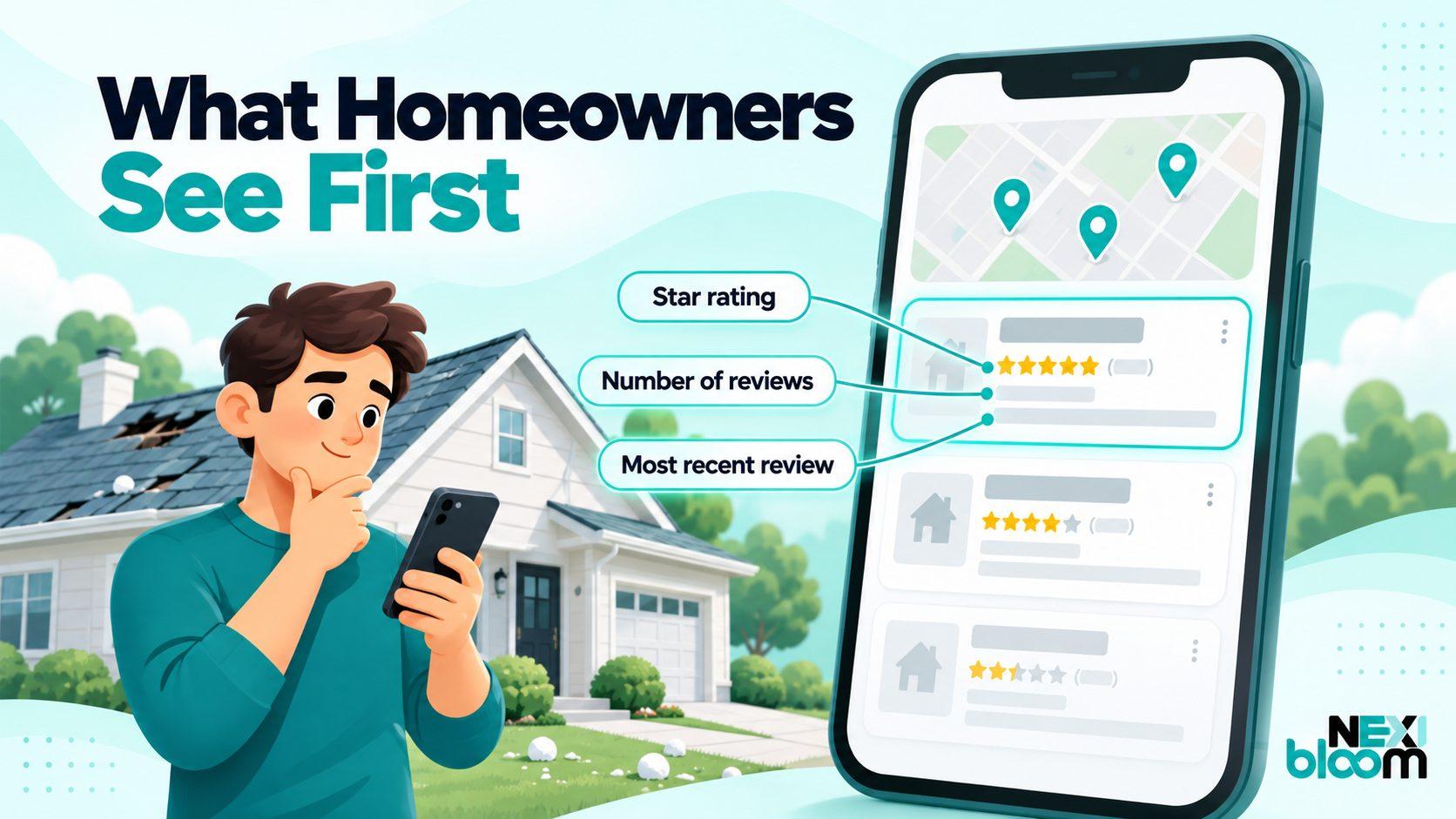
Picture the morning after a hailstorm in west Houston. A homeowner walks out, sees dented gutters and granules washed across the driveway, and picks up their phone. They search "roofer near me." Three businesses appear on a map at the top of the screen, each with a star rating, a review count and a few lines from recent customers.
Most of the time, the decision happens right there. The homeowner does not compare websites or read an About page. They look at the stars, the number of reviews and how recent those reviews are, and they call someone.
That is the real story of roofing SEO in Houston. The competition is not lead aggregators or faceless national brands. It is other good local roofers, and in a crowded market, reviews are often what separates the company that gets the call from the one that never gets considered. Yet most roofers still treat reviews as something that happens by accident.
This guide explains why reviews carry so much weight, the four review signals that matter, how to build a system that brings in reviews every week, what the rules forbid, how to handle storm season, and the rest of the foundation you need to rank.
Key takeaways
- Reviews affect both your map pack ranking and whether a homeowner calls you.
- There is no magic review count. Measure yourself against the roofers you compete with locally.
- Recent reviews matter as much as your total. A steady flow beats an old pile.
- Asking for reviews should be a weekly habit, built into how every job ends.
- Storm season rewards the roofers who were ready before it started.
A roof is one of the most expensive things a homeowner will ever pay for, and most people only buy one or two in their lifetime. They have no experience to draw on, they cannot easily judge the work themselves, and many have heard stories about roofers who took a deposit and disappeared after a storm.
That combination makes homeowners nervous, and nervous buyers lean hard on other people's experiences. Reviews are the fastest way for a stranger to decide whether you are the kind of roofer who shows up, does the job properly and cleans up afterward.
Google is unusually direct about this. Its own guidance on local ranking says that more reviews and positive ratings can help your business's local ranking. The same page makes another point worth remembering: "There's no way to request or pay for a better local ranking on Google."
Google describes local results as being based on three things: relevance, distance and prominence. You cannot change where a homeowner is standing when they search, and relevance mostly comes down to your profile and website matching what they typed. Prominence is where reviews do their work, and it is the one factor you can improve every single week.
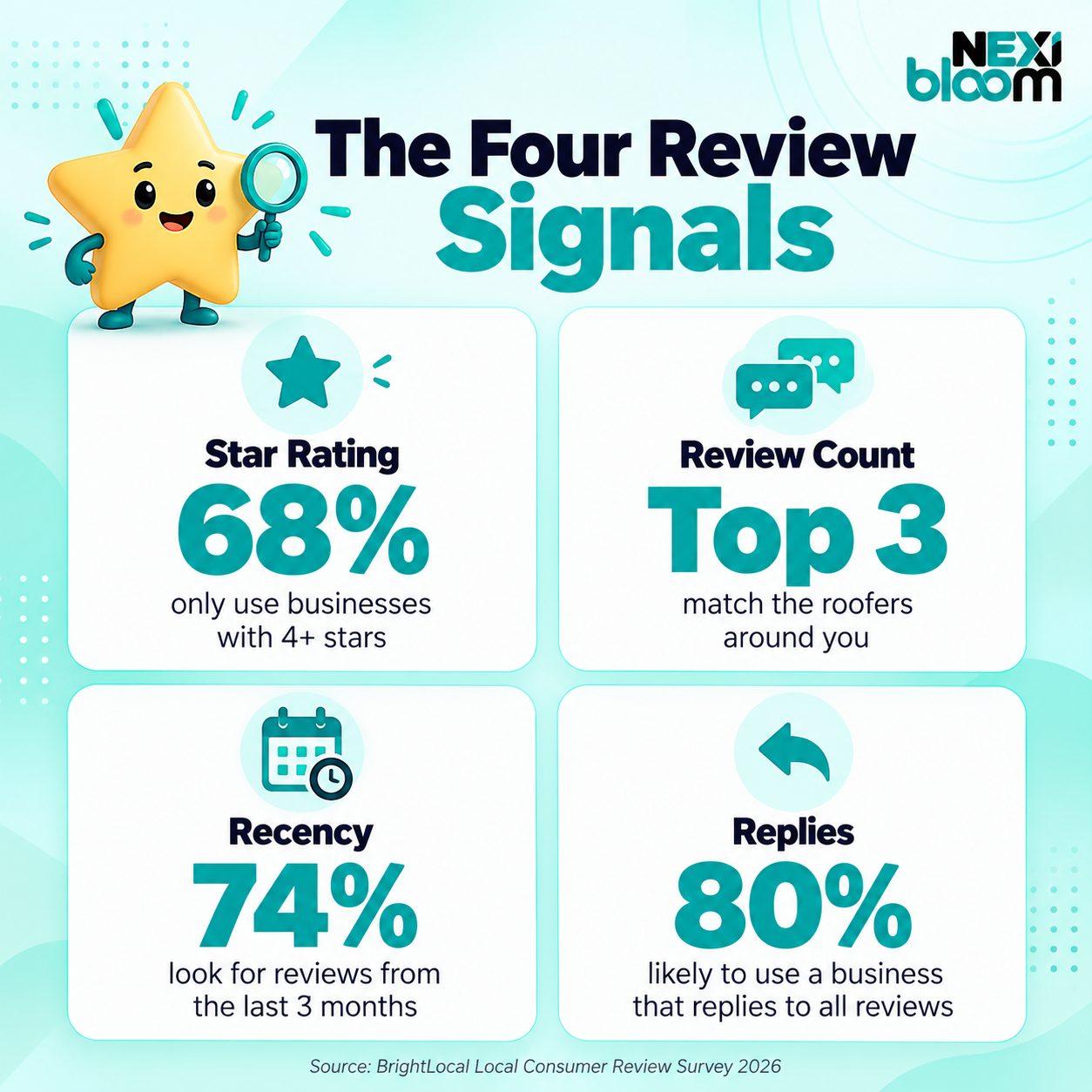
BrightLocal's 2026 Local Consumer Review Survey, based on 1,002 US adults, shows how closely people read reviews before choosing a local business:
For a roofer, those numbers describe a filter. Your reviews decide whether you make the shortlist at all.
It is common to hear that roofing searches are dominated by lead-selling websites and storm chasers. In Houston, that is not what the search results show. Searching for roofing companies in Houston returns actual local roofers almost all the way down the page, with only the occasional directory mixed in.
That changes the challenge. You are not fighting a faceless aggregator with a huge budget. You are competing with other established local roofers, many of whom do good work and have been around for years. When the work is comparable, reviews are often the clearest difference a homeowner can see.
Before you set any review goals, find out what you are actually up against. It takes about 20 minutes:
When you are done, you will have a simple table that shows the real standard in your market. That is your target, and it is far more useful than any national benchmark.
Reviews are not one number. Homeowners and Google look at several things at once, and a weak spot in any of them can cost you calls.
Your average rating is the first thing a homeowner sees, and it works like a pass or fail test. With 68% of consumers only willing to use businesses with four or more stars, a rating below that removes you from most shortlists before anyone reads a word. Above four stars, the higher rating usually wins a side-by-side comparison, which is why the roofers at the top of the map pack tend to sit well above that line.
A perfect 5.0 is not the goal, though. A long run of flawless reviews can look less believable than a strong rating with a few honest criticisms and thoughtful replies.
There is no universal number of reviews that guarantees a top spot. What matters is how you compare with the roofers around you. If the top three results in your area have a few dozen reviews each, getting to that level puts you in the conversation. If they have several hundred, you need a longer plan. This is exactly why the map pack audit comes first.
This is the signal most roofers overlook. BrightLocal found that 74% of consumers look for reviews written in the last three months. A roofer with 200 reviews and nothing new since last year can look less active than one with 60 reviews and fresh ones every week.
A steady pace also looks natural. Reviews that arrive regularly suggest a busy company doing consistent work. Reviews that arrive in one burst and then stop can raise questions for customers and for Google.
How you respond is part of your reputation too. BrightLocal found that 80% of consumers are likely to use a business that responds to all of its reviews, while 42% are unlikely to use one that never replies. Half of consumers are put off by templated responses, so a copied "Thanks for your business!" on every review does little.
Reply to every review, including the five-star ones. Mention the job, the neighborhood or the crew member by name when you can. It shows future customers that real people run the company and that you pay attention.
| Signal | What homeowners check | What to aim for |
|---|---|---|
| Star rating | Whether you clear their minimum | Comfortably above 4.0, with honest reviews |
| Review count | Whether you look established | At or near the level of your local top three |
| Recency | Whether you are active right now | New reviews every week or two |
| Replies | Whether you care about customers | A personal reply to every review |
Most roofers get reviews the same way: occasionally, when a happy customer volunteers one. The roofers who lead the map pack usually do something different. They treat reviews as a step in every job, not a favor they sometimes remember to ask for.
The best moment is right after the final walkthrough, once the cleanup is done and the magnetic sweep for nails has been run across the yard. The new roof is on, the property is clean, and the homeowner is relieved that the project is finished. That is when people feel most generous and remember exactly what went well.
Waiting a week and sending a generic email loses most of that goodwill.
The person the homeowner trusts most should ask, which is usually the project manager or crew lead who was on site. A short, friendly request in person works far better than an automated message from someone they have never met. Something as simple as "If you're happy with how it turned out, a Google review would really help us" is enough.
Follow it the same day with a text that contains a direct link to your review form, so the homeowner can leave the review in under a minute.
Every extra step loses reviews. Use your direct Google review link rather than asking people to search for your business. Put a QR code on the leave-behind card or warranty paperwork. If someone does not respond, one polite follow-up a few days later is fine. More than that starts to feel like pressure.
Reviews that mention the type of work and the area are more useful to future customers, and photos make them even stronger. It is fine to suggest that customers mention what you did and add a photo if they are happy to. It is not fine to script their words or tell them what to say. Let the review be theirs.
Keep a simple weekly count of how many reviews you asked for and how many you received. It takes five minutes and keeps the habit alive during the busy months, when it is most likely to slip.
Because reviews matter so much, there is always a temptation to cut corners. Do not.
Google's review policies forbid offering discounts, gifts or payment in exchange for reviews, posting reviews from employees, family or anyone with a conflict of interest, and selectively asking only happy customers while steering unhappy ones away. That last practice, often called review gating, is common in marketing software and still breaks the rules.
The legal risk is real too. In 2024, the Federal Trade Commission finalized a rule banning fake reviews and testimonials. It prohibits fake reviews, buying reviews and using threats or intimidation to suppress negative ones, and it allows the FTC to seek civil penalties against businesses that break it.
The practical consequences are just as serious. Reviews can be removed and your profile can be restricted. In an industry where homeowners are already wary of storm-season scams, being caught faking trust is about the worst thing that can happen to a roofing company.
Every roofer who does enough jobs will eventually get a negative review. The busiest weeks tend to produce the angriest ones. After a big storm, homeowners wait longer for inspections, insurance claims move slowly, and small miscommunications turn into frustration.
How you reply matters more than the review itself. Stay calm and factual. Acknowledge the frustration, explain briefly what happened without blaming the customer, and invite them to call you directly to sort it out. Keep it short. Future customers are reading your reply to judge how you would treat them if something went wrong.
Never argue in public, and never reveal private details about the job or the customer.
If a review genuinely breaks Google's policies, for example because it is from someone who was never a customer, you can report it through your Business Profile. Google will not remove honest criticism, and a few fair negative reviews with good replies make your overall rating more believable, not less.
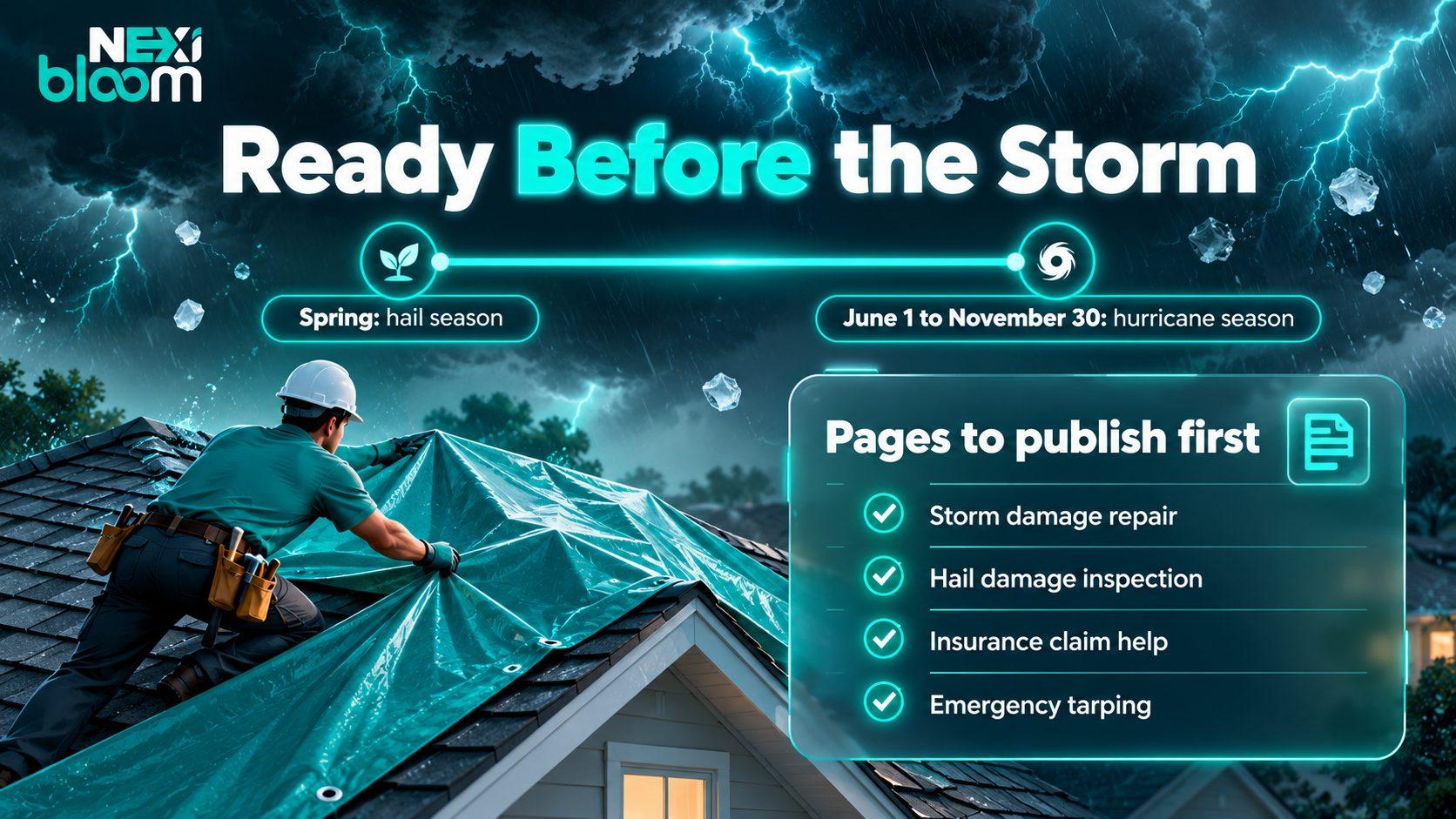
Houston's roofing demand does not arrive evenly. Spring brings hail and severe thunderstorms, and hurricane season runs from June 1 to November 30. Some years bring events that hit the whole city at once, like the May 2024 derecho and Hurricane Beryl in July 2024, and thousands of homeowners start searching for inspections and tarping on the same day.
When a storm hits, it is too late to start building pages. New pages take time to be found, crawled and trusted by Google, so anything written after the storm will rank long after the demand has passed. It is the same timing lesson we covered in our guide to SEO for Houston plumbers, just with hail instead of freezes.
Before spring, make sure you have strong pages for storm damage repair, hail damage inspections, insurance claim help and emergency tarping. If you need help with them, our team writes storm damage and service page copy for contractors.
Storm season brings a rush of jobs, and with it the chance for a rush of reviews. Keep asking every customer, but let the reviews come in naturally as jobs finish rather than sending one mass request to everyone at once. A steady rise during a busy period looks normal. A sudden spike of dozens of reviews in a single day does not.
After major storms, out-of-town crews often arrive, knock on doors and leave once the work dries up. Homeowners know this, which is exactly why reviews from customers in nearby neighborhoods carry so much weight. They prove you were here before the storm and will still be here to honor the warranty.
It also helps to be open about the rules that protect homeowners. The Texas Department of Insurance notes that a state law makes it illegal for contractors or roofers to offer to waive a deductible or promise a rebate for it. Saying so plainly on your storm pages builds trust with the careful homeowners you most want to work for.
Reviews are the entry price, but they work best on top of a solid foundation.
Start with your Google Business Profile. Choose "Roofing contractor" as your primary category, fill in every service you offer, and keep your hours accurate. If customers do not visit your office, set yourself up as a service-area business and hide your address, as Google's guidelines require — our full guide to Google Business Profile for service-area businesses walks through every step. Our team handles local SEO for service-area businesses if you would rather not do it yourself.
Your website needs a separate page for each main service: roof replacement, roof repair, storm damage, insurance claims, metal roofing, commercial roofing and gutters. Each page should clearly explain the work, the process and what homeowners can expect. It should also load quickly on a phone, with a tap-to-call number at the top. If your current site struggles with that, a fast, mobile-friendly roofing website will do more for you than another blog post.
Area pages help too, as long as each one says something real about that area, such as the type of homes, common roof issues or recent jobs nearby. Thirty copies of the same page with different city names will not help, and it can hurt. For an example of how local pages work for nearby markets, see our approach to local SEO in The Woodlands or our guide to local SEO in Sugar Land.
Finally, keep your business name, phone number and details consistent across the directories that matter, including the Better Business Bureau and the contractor directories of any shingle manufacturers whose certifications you actually hold. Our local SEO services cover this groundwork.
Houston SEO agencies generally charge between $800 and $6,000 or more per month, with local SEO on its own typically running from $300 to about $2,050 a month. Where you land depends on how competitive your area is, how much work your website needs and how many services and areas you want to target.
Our SEO packages start from $89.99 a month for the SEO Starter plan. That price is well below the market range, so it is worth being clear about what it covers. The Starter plan includes up to 20 keyphrases and a defined set of monthly tasks, which suits a smaller roofing company building its foundation in a few areas. It is not the same as a full monthly retainer for a multi-location roofer, and "from" means the price rises with the scope of work. For a deeper look at what drives those numbers, see how much SEO costs in Houston.
Track three things. First, calls, website clicks and direction requests from your Google Business Profile. Second, how many new reviews you get each month. Third, where you appear in the map pack for the five searches from your audit, checked once a month from the same locations. If all three are moving in the right direction, the work is paying off. For a fuller checklist, including the warning signs that something has stalled, see our guide on how to tell whether your SEO agency is delivering.
Start with three things. Run the 20-minute map pack audit so you know the real target in your area. Set up the ask-after-cleanup routine with your project managers, including a direct review link they can text from the driveway. Then go through your profile and reply to every review that has not had a response yet.
None of this needs a big budget. It needs consistency. If you would rather have a team build the rest of the foundation around it, our SEO for roofing companies is built for local roofers who want to win the map pack before the next storm, not after it.