- 10919 Stancliff Rd, Apt 4107 Houston, TX 77099
- [email protected]

Office Address
10919 Stancliff Rd, Apt 4107 Houston, TX 77099
10919 Stancliff Rd, Apt 4107 Houston, TX 77099
 by Nexi Bloom LLC


Ask three Houston SEO companies for a quote and you might get three very different numbers. One says $400 a month. Another says $1,800. A third sends a proposal for $5,000. All three promise more traffic, more leads and better rankings, and all three call what they do "SEO."
It is no wonder business owners find SEO pricing confusing. The word covers everything from a few directory listings and a tidied-up Google profile to a full team of strategists, writers, developers and link builders working on your site every week. Two quotes can both be fair and still be describing completely different amounts of work.
This guide sets out what SEO actually costs in Houston, using published pricing data with the sources named, so you can check the numbers yourself. It explains the different pricing models, what drives your price up or down, what you realistically get at each budget, the costs that do not appear on the quote, and the red flags that should make you walk away.
By the end, you should be able to look at any SEO proposal and judge whether the price matches the work.
The quick answer
Most Houston businesses pay somewhere between $300 and $6,000 or more a month for SEO. Where you land depends on who does the work, how competitive your industry is and how much you need done.
Type of SEO Typical Houston price Local SEO for a single location $300 to $2,050 a month Small business retainer $1,500 to $5,000 a month Hourly consulting $75 to $250+ an hour One-off projects (audits, migrations) $1,000 to $30,000+
Most SEO pricing articles quote ranges without saying where they came from. We have tried to do the opposite.
The Houston figures in this guide come from pricing data published by Houston agencies and pricing researchers in 2026, checked in September 2026. Each range is credited to its source in the text. The national figures come from Ahrefs' survey of 439 SEO providers, one of the larger published studies of what SEO professionals actually charge.
Two important caveats. First, these are market ranges, not quotes. Your price will depend on your business, your competitors and what you need. Second, prices change. We will update these figures when our sources publish new data.
Where a source is an agency with its own services to sell, we have said so. Agencies naturally describe the market in a way that suits their pricing, which is exactly why it helps to compare several sources rather than trusting one.
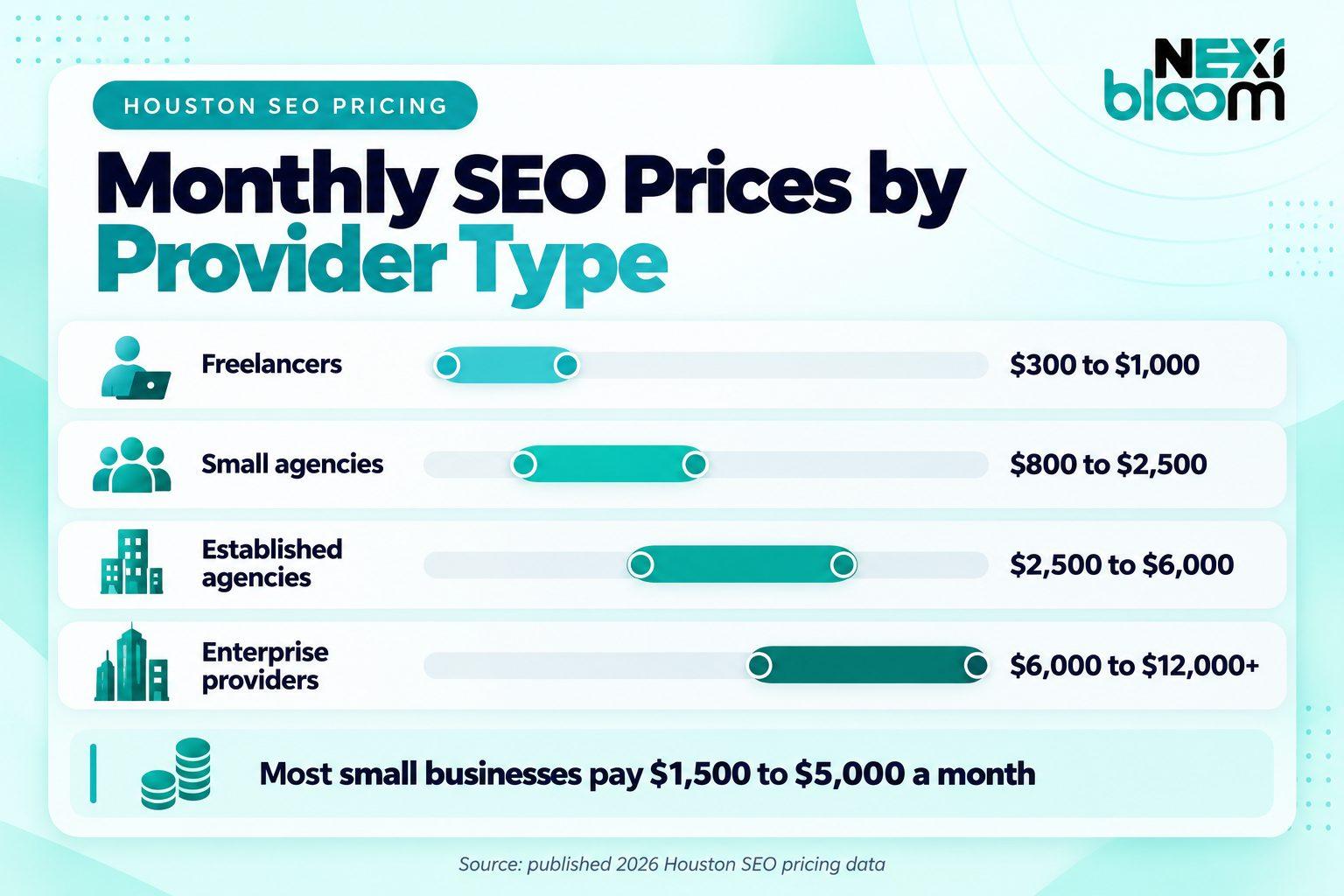
The biggest single factor in your monthly price is who is doing the work. A solo freelancer, a small agency and a large established firm have very different costs, and their prices reflect that.
| Provider type | Typical Houston monthly price | Source |
|---|---|---|
| Freelancers | $300 to $1,000 | DevOptiv, 2026 |
| Small agencies | $800 to $2,500 | DevOptiv, 2026 |
| Established agencies | $2,500 to $6,000 | DevOptiv, 2026 |
| Enterprise-level providers | $6,000 to $12,000+ | DevOptiv, 2026 |
| What most small businesses pay | $1,500 to $5,000 | Authority Solutions |
Put together, that gives the range most Houston businesses will actually see: roughly $800 to $6,000 a month for agency work, with freelancers starting lower and enterprise work going far higher.
Local SEO and "full" SEO are not the same service, and the difference explains a lot of the price variation.
Local SEO focuses on showing up when people nearby search for what you do. That means your Google Business Profile, your presence in the map pack, reviews, local directory listings and a handful of location-focused pages. According to SEO Local's July 2026 data, local SEO in Houston typically runs $300 to $2,050 a month for a single-location business, which it notes is in line with the national baseline.
Full SEO usually includes all of that plus a larger content program, technical work on your website, link building and more detailed reporting. It suits businesses that want to rank across a wider range of searches, not only "near me" terms, and it costs more because it involves more people and more hours.
If you are a plumber, electrician or HVAC company serving part of Houston, local SEO is often the right starting point. If you are a law firm competing across the whole metro, or a company selling online, you will probably need the fuller version. Our team offers local SEO for service-area businesses as well as full SEO services, and the right choice depends on where your customers come from.
Some SEO work is billed by the hour, particularly consulting, audits and advice for businesses with their own marketing staff. Nationally, Ahrefs found that $75 to $100 an hour is the most popular hourly rate for SEO professionals, charged by 24% of the providers it surveyed.
Houston consultants often charge more for experience. Keytomic's 2026 Houston pricing lists $100 to $150 an hour for mid-level consultants, $150 to $250 for senior experts and $250 or more for industry specialists.
Not all SEO is ongoing. Plenty of businesses pay for a single project, such as an audit, a website migration or an initial setup. In Houston, Keytomic puts these at $1,000 to $5,000 for basic audits and setup, $5,000 to $15,000 for comprehensive work, and $15,000 to $30,000 or more for enterprise projects. Many agencies also charge a setup fee at the start of a retainer, which Authority Solutions puts at $500 to $2,500.
If you just want to know where your site stands before committing to anything, a focused project such as an SEO keyword audit is a sensible first step.
Houston is the fourth-largest city in the country, so you might expect SEO to cost far more here than elsewhere. In practice, the difference is smaller than people assume.
Ahrefs' national survey found that $501 to $1,000 a month is the most popular retainer, charged by 20.4% of respondents, and that $2,501 to $5,000 is the most popular fee for a one-off project, charged by 21.2%. SEO Local's data puts Houston local SEO pricing in line with the national baseline.
Houston quotes tend to cluster higher than the single most popular national band, for a simple reason. Houston businesses often compete across a huge metro area with dozens of suburbs, and many sit in crowded industries such as law, healthcare, real estate, energy and home services. The city itself does not make SEO expensive. The competition does.
So a small business serving one Houston neighborhood in a quiet niche may pay close to national rates. A personal injury firm trying to rank across the whole metro will pay far more, and would do so in Dallas, Chicago or Phoenix too.
How you pay affects what you get as much as how much you pay. Here are the main models you will come across in Houston.
This is the most common model. You pay a fixed amount each month, and the provider carries out an agreed set of work: optimizing pages, writing content, building links, managing your Google profile and reporting on progress.
Retainers make sense because SEO results build over time. The risk is vague deliverables. A retainer that says "ongoing optimization" without saying what that means each month makes it very hard to judge whether you are getting value.
Hourly billing works well for consulting, audits, training and businesses with in-house staff who need expert guidance rather than someone to do all the work. It is flexible, but it is hard to budget for, and it rewards time spent rather than results.
A fixed price for a defined piece of work, such as an audit, a site migration or a new website's SEO setup. You know the cost up front and the work has a clear end date. It is ideal for one-time needs, but it does not cover the ongoing work that keeps rankings growing.
Many providers offer tiered packages with set deliverables, often with a limit on the number of keywords or keyphrases they will target. Packages are easy to compare and budget for. The trade-off is flexibility. If your needs do not fit the package, you either pay for things you do not need or miss things you do.
Some providers offer to charge only when you reach certain rankings. It sounds like the safest deal possible, but it often is not. Rankings for obscure terms nobody searches for are easy to hit, and aggressive tactics used to force quick rankings can damage your site later.
Google's own guidance is blunt about this: "No one can guarantee a #1 ranking on Google." Google's own advice on hiring an SEO also warns against providers who claim special relationships with Google or guaranteed placements.
| Model | Typical price | Best for | Watch out for |
|---|---|---|---|
| Monthly retainer | $300 to $6,000+ a month | Ongoing growth | Vague deliverables |
| Hourly | $75 to $250+ an hour | Advice, audits, in-house teams | Unpredictable totals |
| Project-based | $1,000 to $30,000+ | Audits, migrations, launches | No ongoing work |
| Fixed packages | Varies by tier | Small businesses on a set budget | Caps that do not fit your needs |
| Performance-based | Varies | Rarely the right choice | Worthless targets, risky tactics |
Two Houston businesses can get very different quotes for the same-sounding service. These are the factors that explain most of the gap.
Competition is the biggest driver. A personal injury law firm, a cosmetic surgery practice or a real estate brokerage competes with well-funded rivals who have been investing in SEO for years. Ranking there takes more content, more links and more time, so it costs more. Keytomic puts multi-location and competitive-sector SEO in Houston at $5,000 to $10,000 or more a month.
Home services sit somewhere in the middle. Plumbers, HVAC companies, roofers and electricians compete hard in the map pack, but the work is focused on local searches, and seasonality matters as much as budget. We cover how that plays out in what SEO looks like for Houston plumbers.
A specialist business in a quiet niche, such as a piano tuner or an industrial equipment supplier, can often rank with a modest budget because few competitors are trying.
Serving one neighborhood is very different from serving the whole metro. Houston sprawls across a huge area, and many businesses want to reach customers in Katy, Sugar Land, The Woodlands, Pearland, Cypress and beyond. Every additional area usually means more location pages, more local content and sometimes more Google Business Profiles if you have physical locations there. Multi-location businesses pay more because there is simply more to manage.
SEO cannot fix a website that is slow, broken or confusing to use. If your site has technical problems, outdated design or no clear pages for your services, some of your budget will go on fixing the foundation before growth work can start. That might be a one-off cost or a bigger early investment within your retainer.
Content is one of the largest cost components in SEO. A business that needs 15 new service pages, a set of area pages and two articles a month will pay far more than one that already has a strong site and needs light updates.
Getting other reputable websites to mention and link to you, such as local news outlets, industry associations and Houston business directories, remains one of the harder parts of SEO. Done properly, it takes relationship-building, useful content and time. Done cheaply, it tends to involve low-quality links that can hurt more than help.
Houston has a large Spanish-speaking population, and many local businesses serve customers in both English and Spanish. Spanish-language pages can open up searches your competitors are ignoring. They also add real cost, because good bilingual content needs a native-level writer, not a machine translation, and each language version needs its own optimization.
Online stores have thousands of product and category pages to manage, which brings technical complexity that a local service business never faces. Multi-location businesses need consistent profiles, pages and reviews across every location. Both typically sit in the higher price bands.
SEO has a natural pace. You can speed it up by doing more each month, with more content, more links and more technical work, but that means a higher monthly price. A business that is happy to grow steadily over a year will pay less per month than one that wants to compete aggressively within a few months.

This is the part most pricing guides skip. A price only means something when you know what it buys. The bands below describe what is typical in Houston. Individual providers vary, so always check the exact deliverables in any proposal.
At this level, you are usually getting the essentials: keeping your Google Business Profile accurate, listing your business in a handful of directories, basic optimization for a limited number of keyphrases, some review management and occasionally a short article. Our affordable SEO for small businesses is built around this level of work.
Suits: new businesses, very small businesses and companies in low-competition niches or small service areas that need their basics in order.
Cannot do: compete for competitive searches such as "Houston personal injury lawyer" or "AC repair Houston," build a large content library, or earn meaningful links. If a provider at this price promises page-one rankings for competitive terms, be very skeptical.
This band covers solid local SEO for a single-location business. Expect Google Business Profile management, citation cleanup, a few new or improved pages each month, light technical fixes, review strategy and a monthly report.
Suits: single-location service businesses, such as trades, clinics and professional services, that want to show up consistently in the map pack for their area.
Cannot do: much content beyond the core pages, sustained link building, or metro-wide competition in crowded industries.
This is where a full local SEO program usually sits, and it is the band many established Houston small businesses land in. You should expect a proper content plan with several new pieces a month, ongoing technical work, genuine link building, detailed reporting and regular strategy calls with a named person.
Suits: established local businesses that want real growth, including companies expanding into new suburbs or adding services.
Cannot do: dominate highly competitive industries across the whole metro, or run large multi-location programs.
At this level, you are paying for a larger team and a more aggressive program. Expect a dedicated strategist, a substantial monthly content output, ongoing digital PR and link building, conversion work on your key pages and support across several locations.
Suits: businesses in competitive industries such as law, healthcare and real estate, multi-location companies, and businesses where each new customer is worth thousands of dollars.
Cannot do: much it would not be reasonable to expect, but it is overkill for a small single-location business in a quiet niche.
This is enterprise territory: large e-commerce sites, regional brands with many locations, and companies competing nationally as well as in Houston. Expect a full team covering strategy, content, technical SEO, development support and PR, often working alongside your own marketing staff.
Suits: large businesses where organic search drives a significant share of revenue.
| Monthly budget | Typical deliverables | Best suited to |
|---|---|---|
| Under $500 | Profile upkeep, a few directory listings, limited keyphrases | New or very small businesses, quiet niches |
| $500 to $1,500 | Local SEO basics, a few pages a month, monthly report | Single-location service businesses |
| $1,500 to $3,000 | Full local program, content plan, link building, strategy calls | Established local businesses wanting growth |
| $3,000 to $6,000 | Dedicated strategist, heavy content, PR, multiple locations | Competitive industries, multi-location |
| $6,000+ | Full team, technical and development support | Enterprise, e-commerce, regional brands |
We publish our own SEO prices, so it would be odd to write a pricing guide without explaining where they fit.
Our local SEO plans are:
You can see the full list of what each includes on our SEO plans and pricing page.
All three plans sit below most of the Houston market ranges earlier in this guide, and it is worth being honest about why. They are fixed packages with defined, capped deliverables, built for small businesses that want to get their foundations right: a healthy site, accurate listings, reviews under control and a steady trickle of content around a set number of keyphrases.
That makes them a good fit for a small or new business in a manageable area. It also means they are not a like-for-like alternative to a $2,500-a-month retainer for a competitive, multi-location business, and we would not pretend otherwise. A business trying to outrank established firms across the whole of Houston in a crowded industry needs more work each month than any entry-level package can provide.
"From" means exactly that. The prices above are starting points, and they rise with the number of keyphrases, the amount of content and the complexity of the work. If you are unsure which level fits, our small business SEO pricing page explains how we scope it.

The monthly fee is rarely the whole cost of SEO. These are the extras that catch Houston business owners out most often.
Content. Some retainers include writing. Many include only "optimization," which means improving content you supply. If you need new service pages, area pages or articles, check whether writing is included or billed separately. Professional SEO content writing is one of the most common add-ons.
Website fixes or a rebuild. If your site is slow, outdated or built on a platform that is hard to optimize, the SEO provider may recommend changes their retainer does not cover. Sometimes fixing or rebuilding your website is the best SEO investment you can make, but it is a separate cost.
Tools. Professional SEO tools for keyword research, rank tracking and site audits are not cheap. Authority Solutions puts tool costs at $100 to $400 a month. Most agencies absorb this, but some pass it on.
Setup fees. Many retainers start with a one-off setup or onboarding fee to cover audits and initial fixes, typically $500 to $2,500 in Houston.
Links and PR. Some providers charge separately for outreach, sponsored placements or press releases.
Photography and video. Real photos of your team, vehicles and work make a big difference to Google Business Profiles and service pages, and they cost money to produce.
Your own time. SEO needs input from you: answering questions, approving content, asking customers for reviews and sharing news. Budget a few hours a month at least.
Contract terms. Look for minimum contract lengths, early exit fees and, most importantly, who owns the work. You should always own your website, your content, your Google Business Profile and your analytics accounts, whether or not you stay with the provider.
Before signing, ask for these points in writing: what is included, what costs extra, the contract length and exit terms, and confirmation that you own all accounts and content.
Beyond price, you also need to decide who does the work. Each option suits a different kind of business.
A freelancer is usually the lowest-cost option, with freelance SEO in Houston typically running $300 to $1,000 a month. You deal directly with the person doing the work, which many business owners like. The downsides are limited capacity and a single point of failure. If your freelancer gets sick, busy or moves on, your SEO stops. Freelancers also tend to specialize, so one person may be excellent at technical SEO and weaker at content, or the other way round.
An agency brings a team with a range of skills, such as strategy, writing, technical work and link building, and usually more capacity and continuity. The trade-off is a higher price and, at some agencies, the risk that a senior person sells you the service and a junior person does the work. Ask who will actually handle your account.
An in-house hire gives you someone focused entirely on your business. But the true cost is far more than a salary. It includes benefits, tools, training and the management time needed to direct someone in a specialist role. For most small businesses, a full-time SEO hire is hard to justify. It makes more sense once organic search is a major revenue channel.
A hybrid approach is common in growing companies: an in-house marketing coordinator who manages an agency or freelancer, handles approvals and makes sure the work fits the wider business.
| Option | Typical cost | Strengths | Weaknesses | Best for |
|---|---|---|---|---|
| Freelancer | $300 to $1,000 a month | Low cost, direct contact | Limited capacity, single point of failure | Small businesses with simple needs |
| Agency | $800 to $6,000+ a month | Team, range of skills, continuity | Higher cost, possible junior handover | Most growing businesses |
| In-house | Salary plus benefits and tools | Full focus, deep knowledge | Highest total cost, hard to manage | Larger companies where search drives revenue |
| Hybrid | Varies | Control plus expertise | Needs internal time | Growing companies with a marketing lead |
The price only matters in relation to what SEO brings back. To judge that, you need to understand both the timeline and the math.
Local SEO usually starts to show movement within a few months, while competitive searches can take considerably longer. New pages need time to be crawled, indexed and trusted, and reviews and links build gradually.
That makes timing important. A business that starts SEO right before its busy season will often see the benefit only after the season has passed. We explain this timing problem in detail in our guide to SEO for Houston plumbers, where freezes create the same predictable rush every winter. The same seasonal pattern applies to HVAC companies chasing the summer rush and roofers preparing for storm season.
Here is an illustration to show how the numbers work. It is not a client result, and the figures are chosen only to make the math easy to follow.
Imagine a Houston plumbing company paying $1,500 a month for SEO. Its average job is worth $450, and it wins about half of the leads that call.
Now add the long-term value. If a typical customer returns for more work over the following years, or refers a neighbor, each new customer is worth more than the first job. The real return is usually higher than the first-job math suggests.
You can run the same calculation for your business in a few minutes:
If the number of extra leads looks realistic for your market, the budget makes sense. If it looks impossible, you are either paying too much for your situation or need to rethink which services you are targeting.
Many Houston business owners compare an SEO quote with what they already spend on Google Ads or Local Services Ads. The two are priced in completely different ways, which makes a direct comparison tricky.
With paid ads, you pay for each click or each lead. The results start almost immediately, which is their big advantage. But the moment you stop paying, the leads stop too. In competitive Houston industries, costs per click can also climb sharply during busy periods, when many competitors bid on the same searches at the same time.
With SEO, you pay for the work, not for each visitor. It takes months to build, which is its big disadvantage. Once your pages and profile rank, though, they keep bringing in visitors without a charge for every click. Over a year or two, the cost of each lead from organic search usually falls as your rankings strengthen, while the cost of each paid lead stays roughly the same or rises.
That is why most established businesses use both. Ads cover the gap while SEO builds, and they fill in during peak weeks when demand outstrips what organic search alone can deliver. SEO becomes the base layer that keeps working when the ad budget runs out. When you compare costs, compare them over 12 to 24 months rather than a single month, because that is the timeframe in which the difference shows.
Whatever you pay, some warning signs should make you stop and ask more questions. Many of these come straight from Google's own hiring guidance.
Ranking guarantees. Nobody can promise a number one ranking. Google says so directly. A provider who guarantees specific rankings is either targeting searches nobody uses or taking risks with your site.
Secret methods. A good provider should be able to explain what they are doing and why, in plain language. If they will not tell you, assume the worst.
Link schemes and mass submissions. Offers to build hundreds of links quickly, or to submit your site to thousands of directories, are a sign of low-quality tactics that Google specifically warns against.
Unsolicited cold emails. Google warns against providers who contact you out of the blue promising to improve your rankings.
No access to your own accounts. If a provider sets up your Google Business Profile or analytics under their own account and will not give you ownership, you risk losing everything if you leave.
Reports full of vanity metrics. Rankings for words nobody searches, "impressions" with no context, or traffic with no connection to calls and leads. A good report should connect the work to results your business cares about.
It also works the other way. A high price does not guarantee good work. Some expensive agencies deliver polished reports and very little else. Judge every proposal on what it includes and how clearly it explains the results you should expect, not on the price alone.
Copy these into your notes and ask every provider you are considering. The answers will tell you far more than the price.
A good provider will answer all eight without hesitation. Clear, specific answers and clear monthly SEO reporting are a far better sign than a low price.
Once the quotes arrive, the temptation is to compare the monthly figure and pick the cheaper one. A better approach is to put them side by side and compare what each one actually buys.
Here is an illustration with two made-up proposals for the same Houston dental practice.
| Quote A: $900 a month | Quote B: $1,800 a month | |
|---|---|---|
| Google Business Profile management | Yes | Yes |
| New pages or articles each month | 1 | 4 |
| Technical fixes | "As needed" | Monthly audit and fixes |
| Link building | Directory listings only | Local outreach and PR |
| Reporting | Rankings report | Calls, leads and rankings, plus a monthly call |
| Contract | 12 months, exit fee | Month-to-month after 3 months |
| Account ownership | Not stated | Client owns everything |
On price alone, Quote A looks like the better deal. Line by line, Quote B delivers roughly four times the content, real link building and reporting tied to leads, on better contract terms. Quote A might still be the right choice for a practice that only needs its basics in order. The point is that you can only judge value once you see the deliverables.
When you build your own comparison, use the same rows: profile management, content volume, technical work, links, reporting, contract length, exit terms and ownership. Any row a provider cannot fill in clearly is a question to ask before you sign.
If you are still unsure what to spend, work through these five steps.
Before you contact anyone, work out your break-even number using the calculation above. Then get two or three quotes, ask each provider the eight questions on this page and compare what is included, not only the price.
If you have already hired an agency and want to know whether it is delivering, our guide on how to tell whether your SEO agency is actually delivering walks through the signs that matter most.
If you would like a quote built around your business, our Houston SEO services start with a clear explanation of what you need, what it costs and what you can realistically expect.