- 10919 Stancliff Rd, Apt 4107 Houston, TX 77099
- [email protected]

Office Address
10919 Stancliff Rd, Apt 4107 Houston, TX 77099
10919 Stancliff Rd, Apt 4107 Houston, TX 77099
 by Nexi Bloom LLC

Most Houston electricians who invest in SEO chase the same prize: showing up when someone searches "electrician near me." It makes sense on the surface. Those searches happen every day, and the people making them need help.
But look at what that competition actually involves. A crowded map pack, callers phoning three companies and picking the cheapest, and jobs that often mean swapping a breaker or fixing a dead outlet. It is steady work, but it is a hard place to build a profitable business through search.
Meanwhile, a different kind of customer is quietly searching in the background. They have just bought an electric car, or they are thinking about a standby generator after the last big outage. They are asking questions like "do I need a panel upgrade for an EV charger?" and "how much does a Level 2 charger installation cost in Houston?" They research for weeks before they call anyone, and when they search, they mostly find national articles and manufacturer pages rather than local electricians.
That gap is the opportunity. This guide covers where the demand is coming from, how these customers search, the pages you need to build, and the trust signals and profile setup that turn that research into booked jobs.
Key takeaways
- "Electrician near me" is a crowded, price-driven fight. It is worth competing in, but it should not be your only focus.
- EV charger, panel upgrade and backup power jobs are higher value, and customers research them for weeks before hiring.
- The page that wins the most trust answers "do I need a panel upgrade?" honestly, even when the answer is no.
- Your TDLR license, permits and inspections are selling points. Show them.
- Build these pages before demand peaks, not while it is happening.
There is nothing wrong with general and emergency electrical work. It keeps crews busy and brings in new customers. The problem is relying on it as your only source of search traffic.
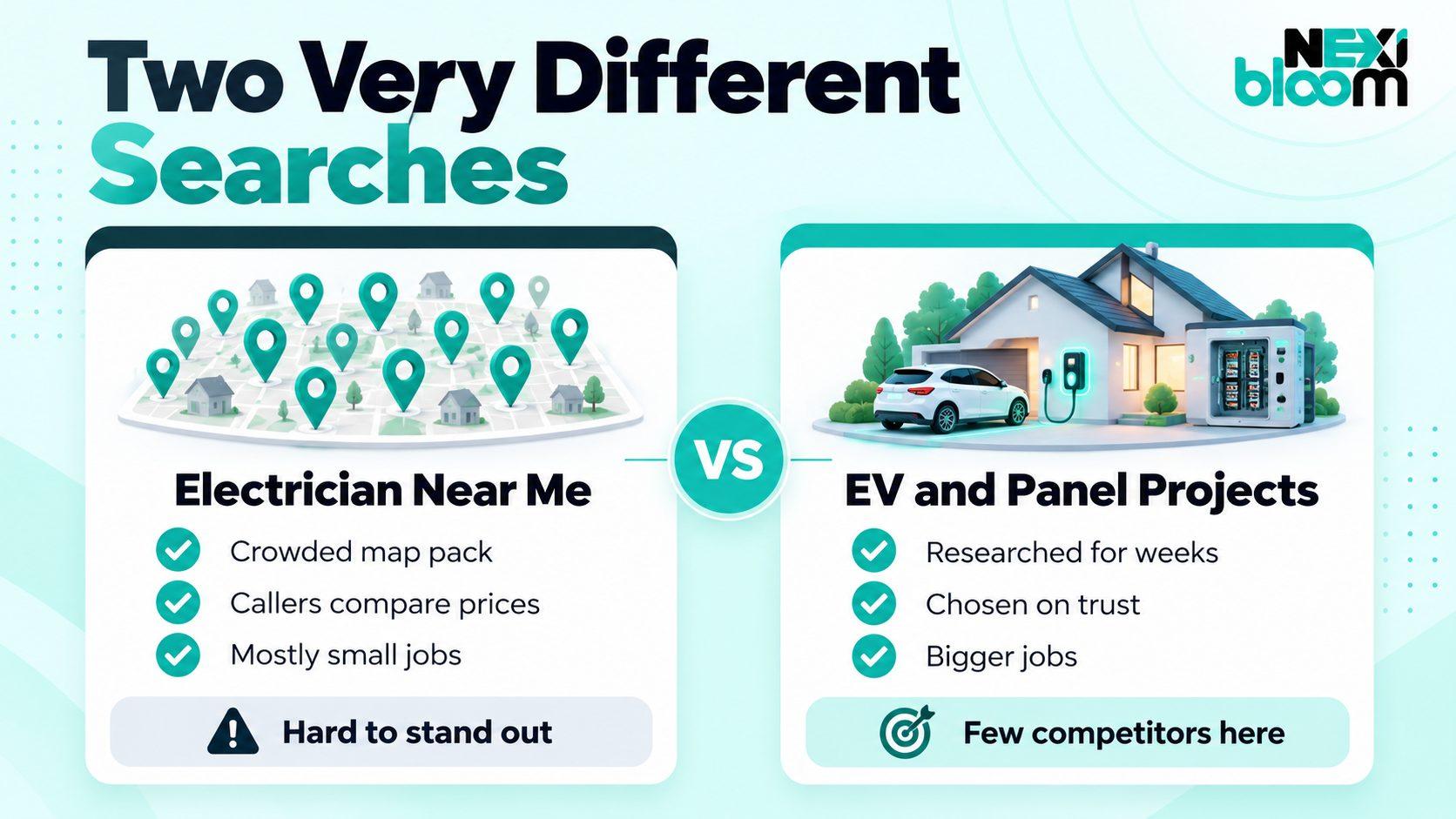
Searches like "electrician near me" and "electrician Houston" are dominated by the map pack, where most electricians look much the same to a homeowner: a name, a star rating and a phone number. Many callers are looking for the fastest or cheapest option for a small job. They phone several companies, compare quotes and move on. Winning that search takes a strong profile and a lot of reviews, and even then, the average job is modest.
Planned projects work differently. A homeowner installing an EV charger, upgrading an old panel or adding a whole-home generator is spending real money on something that affects the safety of their house. They do not want the cheapest electrician. They want the one who clearly knows this type of work, explains it well and seems trustworthy. They read several pages, compare options and often contact only one or two companies.
That shift, from price to trust, is exactly where good content and SEO do their best work. You are not trying to be the fastest answer. You are trying to be the most helpful one.
So keep your general service pages and your emergency pages. Just do not stop there. The electricians who build out high-value project pages alongside their everyday services give themselves a second, more profitable stream of leads that most of their competitors are not even trying for.
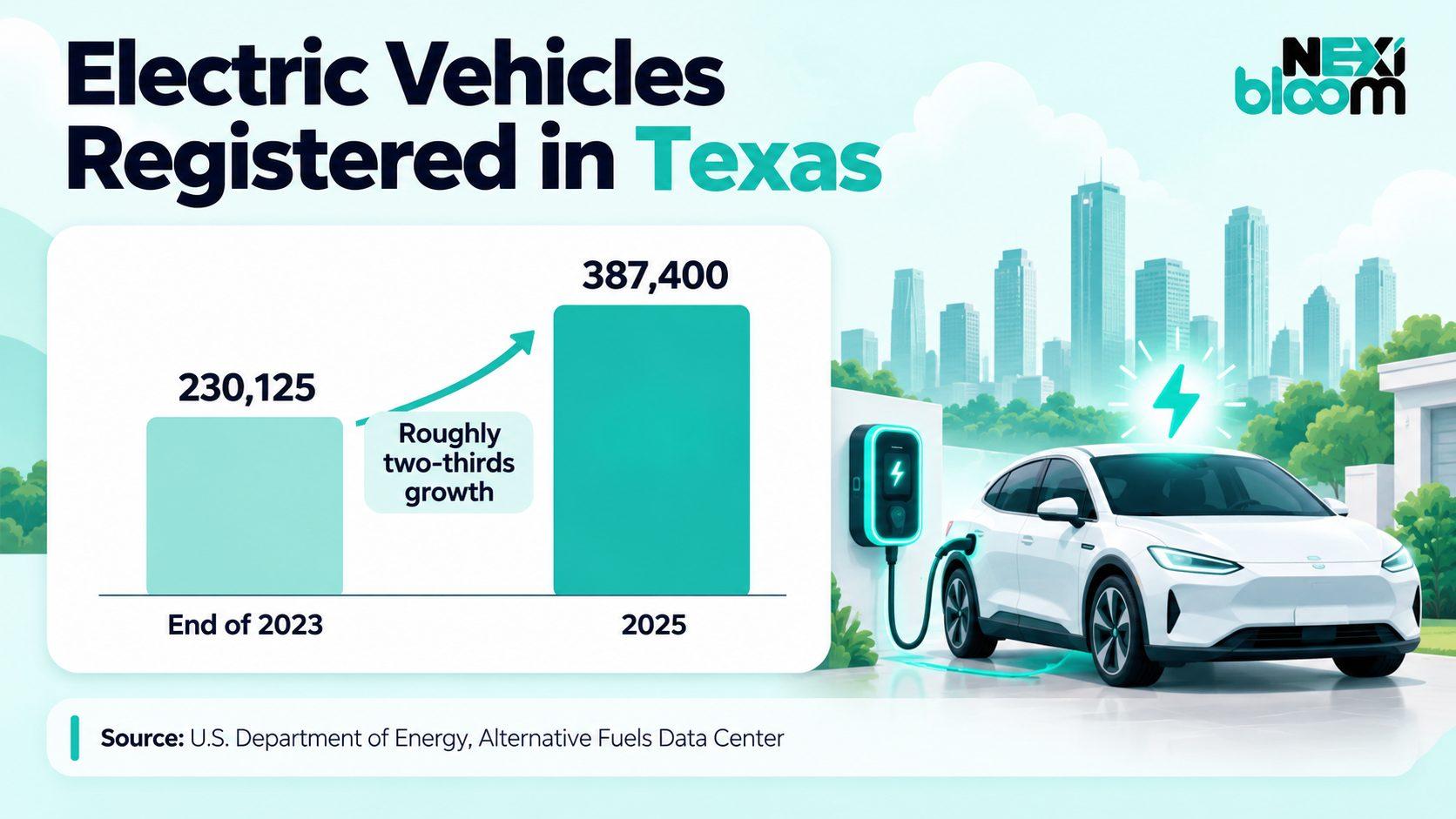
Electric vehicles are no longer a niche in Texas. According to the Department of Energy's Alternative Fuels Data Center, Texas had 230,125 registered all-electric vehicles at the end of 2023. By 2025, Texas had more than 387,000 registered electric vehicles. That is growth of roughly two-thirds in about two years.
These are statewide figures, and not every one of those drivers lives in Houston. But the Houston metro is the largest population center in the state, and the direction is clear. Every year, more households in and around the city own a car that needs charging at home.
Many EV owners start by charging from a standard outlet and quickly discover how slow it is. The usual next step is a Level 2 charger, which runs on a 240-volt circuit and charges several times faster. That means a new dedicated circuit, sometimes a new outlet, and often a question about whether the home's electrical panel can handle the extra load.
The electrical code treats EV charging as a continuous load, which means the circuit has to be sized with extra headroom. In a home that already runs central air, an electric dryer and an electric water heater, that headroom may not be there. Some homes can add a charger easily. Some need a load calculation to confirm. Some need a panel or service upgrade first. Every one of those outcomes starts with a homeowner looking for an electrician they trust.
Houston has a wide range of housing stock, from older homes in established neighborhoods to large new developments on the edges of the metro. Older homes are more likely to have smaller or outdated panels that were never designed for today's electrical demands. Newer homes are often built with more capacity, and some come wired with EV charging in mind.
For an electrician, that means the questions differ by area. A homeowner in an older part of the city may need a full panel upgrade before a charger is possible. A homeowner in a newer suburb may only need a circuit run to the garage. Content that recognizes those differences will feel far more useful than a generic national article.
EVs are not the only reason Houston homes need more electrical capacity. After Hurricane Beryl left much of the region without power in July 2024, many homeowners started looking seriously at standby generators and home battery systems. Solar installations, heat pumps, electric kitchens and even hot tubs all add load too.
Each of these leads back to the same question: can my panel handle it? That question, and the jobs that follow it, is where the opportunity sits.
Residential chargers are only part of the picture. Apartment and condo owners, office parks, retail centers and businesses running small vehicle fleets are all adding charging too, and those projects are usually larger than a single garage installation. They also involve different decision-makers, such as property managers, facility managers and business owners, who search in a more businesslike way, with terms like "commercial EV charger installation Houston" or "workplace charging electrician."
If you have the capacity and experience for commercial work, a separate page aimed at those buyers is worth building. It should talk about planning, load capacity across multiple units, permits, timelines and ongoing maintenance, rather than the homeowner concerns on your residential pages.
For several years, homeowners in eligible areas could claim a federal tax credit for installing a home EV charger, worth up to 30% of the cost and capped at $1,000. That credit is no longer available. The federal home charger credit expired on June 30, 2026.
Plenty of websites still promote it as if it were current. If your own pages mention it, update them. Being accurate on a detail like this is a small thing that shows homeowners you know what you are talking about.
These customers do not search the way emergency callers do. They move through stages, starting with questions, moving on to costs and comparisons, and only then looking for a local electrician to hire.
In the early stage, they ask things like "do I need a panel upgrade for an EV charger," "100 amp vs 200 amp panel," or "can I install a Level 2 charger on my current panel." They want to understand their situation before they talk to anyone.
In the comparing stage, they search for costs and options: "Level 2 charger installation cost Houston," "smart panel vs panel upgrade," or "whole home generator install Houston." They want to know what they are likely to spend and what the choices are.
In the ready-to-hire stage, they search for a provider: "EV charger installer Houston," "panel upgrade electrician Katy" or "electrician for generator installation near me." By this point, they often already have a company in mind, usually the one whose page answered their earlier questions.
| Example search | Stage | Best page to send them to |
|---|---|---|
| Do I need a panel upgrade for an EV charger? | Learning | Panel upgrade question page |
| 100 amp vs 200 amp panel | Learning | Panel and service upgrade page |
| Level 2 charger installation cost Houston | Comparing | Cost factors page |
| Smart panel vs panel upgrade | Comparing | Panel upgrade question page |
| EV charger permit Houston | Comparing | EV charger installation page |
| EV charger installer Houston | Ready to hire | EV charger installation page |
| Whole home generator install Houston | Ready to hire | Generator and backup power page |
The lesson is simple. If you only have a page for the final stage, you meet these customers at the very end, when they have already been reading someone else's advice for weeks. If you have pages for every stage, you are the company that helped them from the start.
This is the practical heart of the strategy. You do not need dozens of pages. You need a small set of genuinely useful ones, each built around a clear question.
This is your main page for EV work. It should explain the whole process in plain language, so a homeowner knows exactly what to expect:
Include the types and brands of chargers you install, and whether homeowners can supply their own. Explain what affects the price, such as the distance from the panel to the charger location and whether the panel needs work. Add real photos of your installations, a clear phone number at the top and a simple way to request a quote.
Many homeowners do not know whether they need a panel upgrade, a service upgrade or both, so explain the difference clearly. Cover the common signs that a panel needs attention: breakers that trip regularly, an old or obsolete panel, no room for new circuits, or plans for major new loads such as an EV charger, generator or heat pump.
Explain what a typical move from 100 to 200 amps involves, including coordinating with the utility, pulling permits and passing inspection. In most of the Houston area, that means working with CenterPoint, which manages the power lines and meters. Give an honest sense of how long the process usually takes, because this is one of the first things homeowners want to know.
This is the page that can set you apart from almost every competitor, and it works because it is honest.
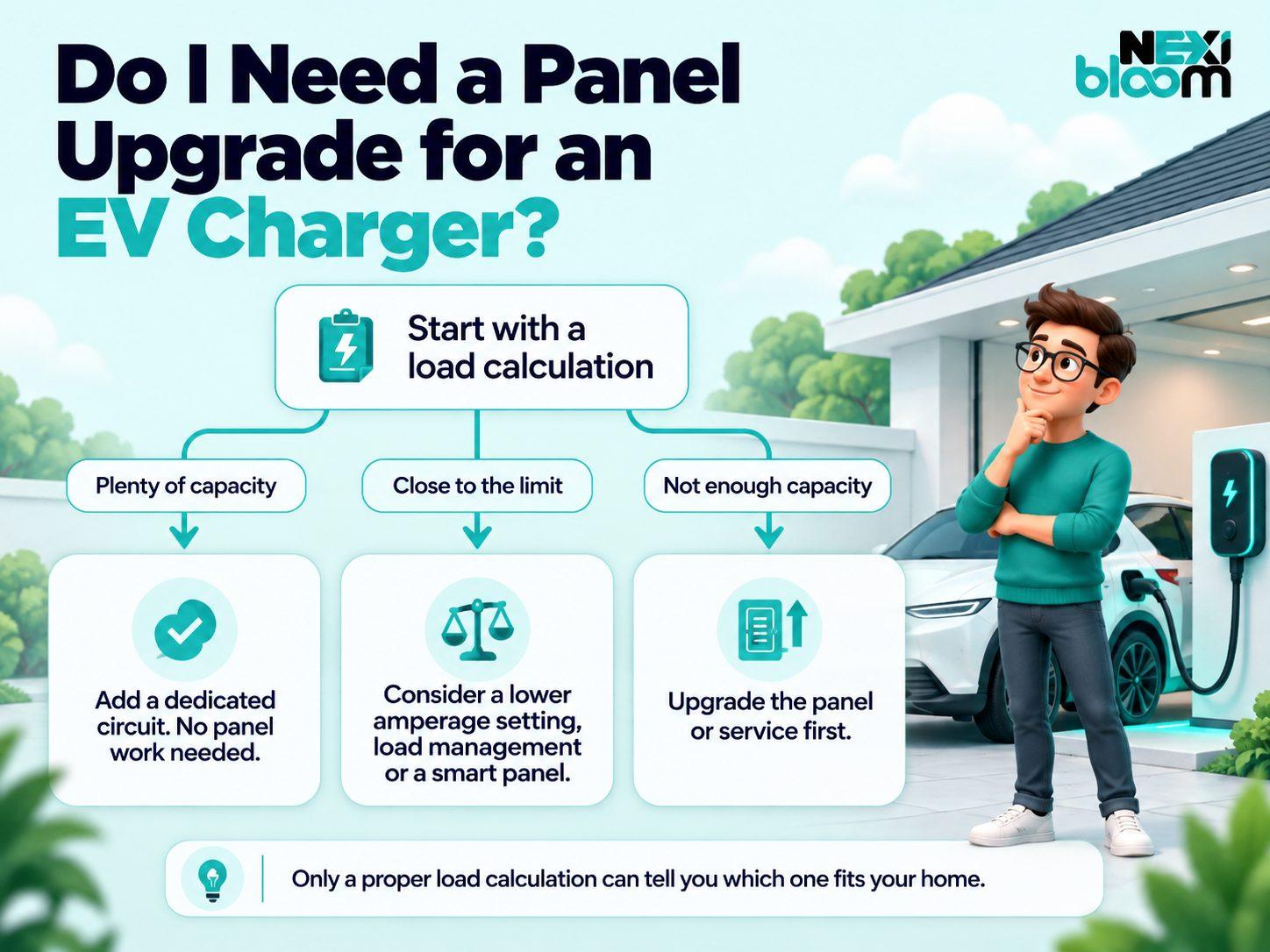
The true answer is: it depends. Some homes have plenty of spare capacity and can add a charger with no panel work at all. Some homes are close to their limit and need a load calculation to be sure. Some need an upgrade.
Walk through that clearly. Then explain the alternatives that can sometimes avoid an upgrade, such as a charger set to a lower amperage, load management devices that pause charging when other appliances are running, or a smart panel. Be honest that these are not right for every home, and that a proper load calculation is the only way to know.
An electrician who tells a homeowner "you might not need the expensive option" earns trust that no advertisement can buy. And when that homeowner does need an upgrade, now or later, they know exactly who to call. If writing pages like this is not your strength, our team creates EV and panel service page copy for electrical contractors.
Homeowners want to know what they are likely to spend before they call, and a page that explains costs honestly will attract a lot of that research traffic.
You do not need to publish exact prices, and it is usually better not to, since every job is different. Instead, explain what drives the cost: the distance between the panel and the charger, whether the panel has capacity, whether a service upgrade is needed, permit fees, and any trenching or wall work. A clear breakdown like this helps the homeowner understand your quote when it arrives, which makes the sale easier.
Standby generators are another high-value project, and in Houston, demand is closely tied to hurricane season and major outages. Explain the options, from portable generator connections to whole-home standby systems, and what installation involves, including transfer switches, permits and fuel supply. Connect it back to your panel page, because many generator installations raise the same capacity questions.
Link all of these pages to each other and to your contact page. A homeowner who lands on the question page should be able to reach the EV charger page, the cost page and your phone number in one click. All of this works best on a fast, mobile-friendly electrician website that loads quickly on a phone and makes calling you easy.
When someone is about to spend real money on work inside their walls and panel, trust decides who gets the job. These are the signals that matter most.
Your license. In Texas, anyone who performs electrical work must be licensed, and an electrical contracting business must hold a Master Electrician license or employ a Master Electrician of Record. Display your TDLR license number clearly on your website and in your profile, and tell homeowners they can check it in TDLR's license database. Careful homeowners do check, and being upfront about it signals confidence.
Permits and inspections. Say plainly that you pull permits and that your work is inspected. Some homeowners worry that permits mean extra cost or delay. Explain that the inspection protects them, their insurance and the resale value of their home.
Certifications. If you hold installer certifications from charger or generator manufacturers, show them. Only list certifications you actually hold.
Insurance and warranty. Make your insurance and workmanship warranty easy to find.
Real photos. Photos of clean panel work and tidy charger installations tell a homeowner more about your standards than any amount of text.
Your Google Business Profile is still where many customers first see you, so set it up to reflect the work you want more of.
Choose "Electrician" as your primary category, since it matches most searches. Then look through the secondary categories for options that match your specialist work. If Google offers a category for EV charging contractors when you search the list, consider adding it.
In your services list, add EV charger installation, panel upgrade, service upgrade and generator installation as separate services with short descriptions. That helps Google understand what you do and shows customers you specialize in it.
If customers do not visit your office, set yourself up as a service-area business and hide your address, as Google's guidelines require—our guide to Google Business Profile for service-area businesses walks through that process in detail. Choose your service areas realistically, based on where you can actually get to promptly.
Add photos of your EV charger installations, panel upgrades and generator work regularly, and use posts to share useful updates, such as a note that the federal charger credit has ended or a reminder to book generator installations before hurricane season. If you would rather have this handled for you, our team provides local SEO for service-area businesses across Houston.
For high-value work, reviews do double duty. They help your ranking, and they reassure the next homeowner who is nervous about a big project.
The best time to ask is after the inspection passes and the charger is working, when the homeowner has just plugged in their car for the first time. That is when they feel the benefit most clearly. A short request in person, followed by a text with a direct link to your review page, works well.
Reviews that naturally mention the charger, the panel upgrade or the generator are especially useful, because they speak directly to future customers researching the same project. You can encourage customers to mention what you did, but do not script their words. For a practical approach, see how Houston roofers build a weekly review system that keeps fresh feedback flowing.
Reply to every review with specifics. A reply that mentions the charger installation or the panel upgrade reinforces what the job was, for both readers and Google.
If you serve customers across the metro, pages for your main areas can help you appear in local searches beyond your base. The key is making each one genuinely useful.
A good area page talks about what is specific to that area. The typical age and type of homes, the panel situations you commonly find there and recent jobs you have completed nearby all make a page worth reading. An older neighborhood where panel upgrades are common deserves different content from a newer suburb where most of your work is running circuits for chargers.
What does not work is thirty copies of the same page with the city name swapped. Google treats those as low-quality, and homeowners can tell. Start with a few strong pages for the areas that bring you the most valuable work, and add more when you have something real to say. For an example of how local pages work in nearby markets, see our approach to local SEO in Katy and our guide to local SEO in Sugar Land.
A few problems come up again and again when we look at electrical contractors' websites, and each one costs leads.
New pages do not rank overnight. Google has to find them, crawl them and decide they deserve to rank, which takes weeks at the very least and often months for competitive searches.
EV demand grows steadily rather than in seasonal bursts, so the best time to build those pages is simply as soon as possible. Generator demand is different. It rises before hurricane season and spikes after major outages. A generator page published after a storm will rank long after the rush has passed.
This is the same timing lesson we covered in our guide to SEO for Houston plumbers, where frozen pipe pages need to be live by October. For electricians, the generator page should be live well before June.
Paid ads and SEO both have a place, and they suit different kinds of work.
For emergency and general electrical calls, Local Services Ads and search ads can bring in leads quickly. Customers with an urgent problem often call the first trustworthy option they see, and ads put you there immediately.
EV and panel customers behave differently. They are researching, reading and comparing over several weeks, and they are more likely to trust a helpful page than an ad. That makes organic content especially effective for this work, because it keeps answering their questions without a charge for every click.
Most electrical contractors benefit from using both: ads for urgent work and to fill gaps while SEO builds, and organic pages as the long-term source of high-value project leads. If you want help with the paid side, our team handles PPC management for local service businesses.
Houston SEO agencies generally charge between $800 and $6,000 or more a month, depending on the size of the provider and the scope of work, and local SEO on its own typically runs from $300 to about $2,050 a month—our breakdown of how much SEO costs in Houston covers the full range. For a single-location electrician, the right budget depends on how many services and areas you want to target and how much content your site needs.
Our SEO packages start from $89.99 a month for the SEO Starter plan, which covers up to 20 keyphrases and a defined set of monthly tasks. That suits a smaller electrical company building its foundation. It is not a like-for-like replacement for a full monthly retainer, and "from" means the price rises with the scope of work.
Google Search Console shows the searches that bring people to your site. Filter for searches containing "EV," "charger," "panel" and "generator" and watch whether impressions and clicks rise over the months after your pages go live. Alongside that, track calls and quote requests by page, so you know which pages actually bring in work. If the EV and panel pages are generating enquiries, the strategy is working. If you are unsure about your provider's results, our guide on how to tell whether your SEO agency is delivering lays out the benchmarks to check.
Start with two pages: an EV charger installation page and an honest "do I need a panel upgrade?" page. Add EV charger installation, panel upgrade and generator installation as separate services on your Google Business Profile. Then make sure your TDLR license number appears on every page of your website.
Those three steps alone put you ahead of most Houston electricians. If you would rather have a team build the rest around them, our Houston SEO services help local contractors win the jobs worth winning, not just the ones everyone else is fighting over.